Art

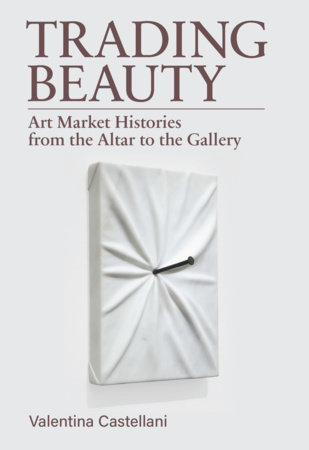
Trading Beauty: Art Market Histories from the Altar to the Gallery

Trading Beauty traces the evolution of the Western art market from the medieval era to the present day, examining how social, cultural, religious, and economic circumstances have informed distinct models of art production, validation, and valuation.

Inextricably linked to the history of art are the stories of its markets. Trading Beauty surveys the evolution of the Western art market from the medieval era to the present day. In thirteen chapters informed by her expertise as a veteran of Sotheby’s auction house and Gagosian gallery, Valentina Castellani analyzes how the social, cultural, religious, and economic circumstances of distinct historical periods have defined disparate models of art production, validation, and valuation.

Castellani traces developments from the Middle Ages and Renaissance—when the patronage of the Church and aristocracy steered all art production—to the birth of the first free market for art during the Dutch Golden Age, and the imposition of state control by the Academies and royal manufactories during the absolute monarchy of Louis XIV. She examines the genesis of the gallery system, which emerged in the second half of the nineteenth century alongside Impressionism, was fortified by the pioneering dealers of modernism and postwar art as the art world’s epicenter shifted from Paris to New York, and remains ascendant today.

As Castellani recounts, the art market’s scope has continued to grow, with African American artists of the Harlem Renaissance and beyond establishing alternative models to counteract their exclusion from the globally dominant art world, Damien Hirst selling new work at auction in 2008 as a challenge to the gallery system, contemporary commercial galleries taking on the role of museums by staging blockbuster exhibitions of historical art, and the expansion of infrastructures in China and the Middle East. Post-pandemic social and cultural changes, the rise of digital technologies, and generational shifts in collector demographics hold out the promise of a more decentralized, diverse, and democratic art world that offers overdue critical and market attention to previously marginalized women and Black artists.

Castellani’s chronicles of these various histories, peppered with anecdotes spotlighting game-changing characters and record-shattering sales, provide insight into the mechanisms that have shaped the art market as we know it today.

About The Author

Valentina Castellani’s extensive knowledge of the art world and market is shaped by a distinguished career spanning leading roles at Sotheby’s auction house and Gagosian gallery, and as an independent dealer. During her tenure as deputy director at Sotheby’s in London and New York, she was instrumental in launching the inaugural 20th-Century Italian Sale, and played a key role in securing landmark works of art from major private collections. She subsequently spent eleven years as senior director at Gagosian in New York, where she spearheaded the organization of some of the gallery’s most acclaimed exhibitions, including major shows dedicated to Francis Bacon, Lucio Fontana, Piero Manzoni, and Pablo Picasso. Since departing Gagosian in 2016, Castellani has focused on the secondary market for postwar and contemporary art. In 2019, she joined the faculty of the Steinhardt School of Culture, Education, and Human Development at New York University as an adjunct professor in the Master’s program in Visual Arts Administration. She serves on the board of Casa Italiana at NYU and is cochair of the board of the Drawing Center. She lives in New York with her husband.

  • Publish Date: September 08, 2026
  • Format: Trade Paperback Original
  • Category: Art - History - General
  • Publisher: Gagosian / Rizzoli
  • Trim Size: 6-7/10 x 9-4/9
  • Pages: 272
  • US Price: $40.00
  • CDN Price: $55.00
  • ISBN: 978-1-968417-02-4